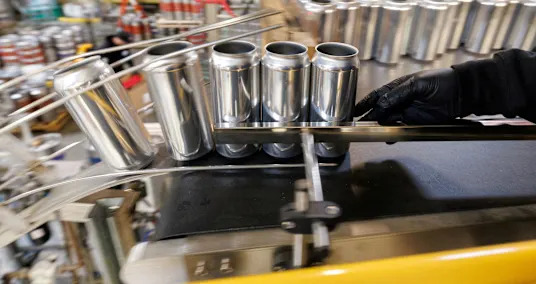
Sorry, penny pinchers. The United States ended production of the penny on Wednesday, more than two centuries since the one-cent coin first went into circulation.
The move is part of an effort to retire the country’s smallest denomination, which had cost nearly four times its value to produce.
The country’s final pennies were pressed at the U.S. Mint in Philadelphia, where they’ve been produced since 1793, a year after Congress authorized the Coinage Act.
The last two pennies were stamped with a special marking and will not go into circulation. According to the Associated Press, the government plans to auction them off in the future.
In a statement, the Treasury Department said that “ongoing increases in production costs and the evolution in consumer habits and technology have made its production financially untenable."
The last coin before the penny to be discontinued was the half-cent in 1857. And there could be more change to come.
What led to the penny’s death?
For years, retailers and lawmakers have been advocating for the U.S. to abolish the penny. In February, President Trump ordered Treasury Secretary Scott Bessent to halt penny production, saying it was “so wasteful.” A bill introduced in Congress earlier this year called the Common Cents Act would formalize Trump’s order. It has not yet been passed.
How much did each penny cost to produce?
According to the U.S. Mint, the cost of producing each penny is 3.69 cents per coin — more than triple its face value. By no longer producing pennies, the U.S. is expected to save an estimated $56 million annually.
How many pennies are in circulation?
There are currently an estimated 300 billion pennies in circulation, according to the Treasury Department.
Can you still use pennies?
Yes. The penny "remains legal tender and will retain its value indefinitely," the Treasury Department said.
Will banks stop accepting pennies?
No. You can still deposit pennies at the bank. In fact, the American Banking Association is encouraging people to bring them to the bank to help ease any shortages.
What happens if a store runs out of pennies?
In recent weeks retailers have expressed concerns that their supplies of pennies are running low. To cope, some have rounded prices down to the nearest nickel.
Are nickels and dimes next?
Nickels? Maybe. Dimes, maybe not.
According to the U.S. Mint, the nickel costs nearly 14 cents to make, nearly triple its market value. For nearly two decades, both the penny and nickel have cost more to produce than they are worth, per U.S. Mint figures.
Dimes, though, cost roughly 6 cents to produce. Quarters cost about 15 cents to make. So they’re probably safe for now.
LATEST POSTS
- 1
 Merz visit highlights new strategic, and strained, Germany-Israel bond
 - 2Viable Tips for Seniors to Purchase a Minimal expense Jeep Wrangler
- 3Chris Noth responds to backlash after seemingly shading 'Sex and the City' costar Sarah Jessica Parker: 'It is not news'
- 4Hundreds are quarantined in South Carolina as measles spreads in 2 US outbreaks
- 5Our favorite Space.com stories of 2025


- What we know about Renee Nicole Good, the woman who was killed by an ICE officer in Minneapolis
- Savvy Cleaning: The 6 Robot Vacuums of 2024
- Make Your Fantasy Closet: 10 Immortal Design Fundamentals
- Anger as German family business group opens talks with far-right AfD
- Should you get an RSV vaccine this fall? What to know and where to get a shot
- Gulf aluminum output tumbles on Iran war
- How Would You Like to Deal with Your Funds?
- NASA's Artemis 2 moon launch seen from space | Space photo of the day for April 2, 2026
- US measles cases surpass 2,000, highest in 30 years: CDC